ERP Integration
❤️ When the ERP system is the heart of your company, everything around it must work
In many companies, the ERP system is the center of all business processes. Orders are processed here, inventory is managed, invoices are created and deliveries are organized. Online shops, marketplaces, CRM systems or logistics platforms are often just individual components within a larger system landscape. For these systems to work efficiently together, they must be properly integrated.
Modern ERP integration ensures that all systems communicate with each other automatically. Products, prices, orders, customers and inventory are synchronized automatically – without manual data transfers.
This reduces errors, saves time and enables scalable business processes.
⚙️ Why ERP integration is essential today
Many companies start with isolated systems.
A shop is introduced.
An ERP system already exists.
A CRM is added later.
Marketplaces and logistics systems follow.
Without integration, typical problems quickly arise:
- data must be maintained multiple times
- orders are transferred manually
- inventory levels become inaccurate
- prices differ between systems
- employees spend a lot of time with Excel and imports
As the business grows, these problems grow as well.
A proper ERP integration ensures that systems no longer operate in isolation, but become part of a shared infrastructure. All systems access the same information – automatically and reliably.
🧠 The ERP as the central data platform
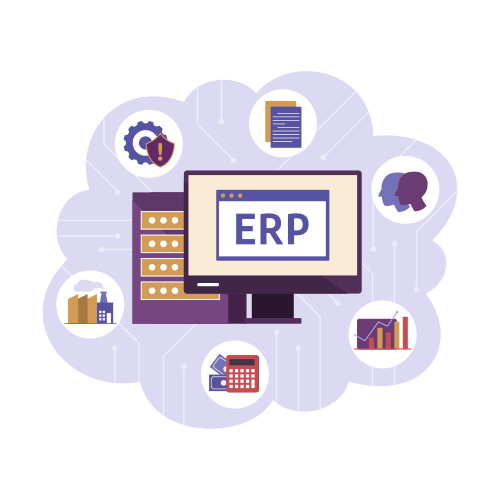
In most companies, the ERP system is the central platform for operational business processes.
This typically includes:
- product master data
- pricing logic
- customers and accounts
- inventory levels
- orders and sales processes
- invoicing and accounting
- deliveries and logistics
For this reason, the ERP system is often used as the single source of truth.
Other systems access this data or send new information back.
For example:
- the online shop sends orders to the ERP
- the ERP provides prices and inventory to the shop
- shipping status is returned to the customer
Through this bidirectional synchronization, all systems remain consistent.
🏗️ Typical system architecture
In modern companies, the system landscape often consists of several specialized systems.
ERP System
│
├─ Online Shop (Shopware / Shopify)
├─ Marketplace Integrations
├─ EDI Supplier Integration
├─ CRM / Marketing Systems
├─ Logistics / Shipping Software
└─ Custom Business Software
The challenge is to connect these systems reliably.
Depending on the architecture, this is done via:
- APIs
- middleware
- event-based integrations
- custom interfaces
👉 Learn more: System Integration
🔄 Which data is synchronized between ERP and other systems
ERP integration does not only connect databases, but entire business processes.
Typical data flows include:
Product data
- product master data
- variants
- categories
- prices and price lists
- B2B pricing logic
Inventory and availability
- inventory levels
- reservations
- delivery times
- multi‑warehouse logic
Orders
- order transfer to the ERP
- order processing
- invoicing
- shipping status
- tracking numbers
Customers
- customer accounts
- shipping and billing addresses
- payment terms
- customer-specific pricing
When this data is synchronized automatically, end‑to‑end processes emerge – from the first customer interaction to invoicing.
🛒 ERP integration in eCommerce
Especially in online commerce, stable ERP integration is crucial.
An online shop must always know:
- which products are available
- which prices apply
- how long delivery times are
If the shop and ERP are not properly connected, problems quickly arise:
- products are sold even though they are out of stock
- prices are incorrect
- delivery times are wrong
ERP integration ensures that the shop and backend systems always remain synchronized.
👉 Learn more: eCommerce Development
🤖 Automated business processes
A good ERP integration automates many processes in the background.
For example:
- A customer places an order in the online shop
- The order is automatically transferred to the ERP
- The order is processed there
- Inventory is updated
- Shipping is prepared
- The tracking number is returned to the shop
The entire process runs automatically.
This saves time and reduces errors.
🚀 Benefits of professional ERP integration
More efficient processes
Manual data entry is eliminated and many processes are automated.
Consistent data
All systems access the same information.
Faster order processing
Orders can be processed more quickly.
Scalability
Growing order volumes can be handled easily.
Better decision making
All relevant data is available centrally.
ERP integration reduces data silos and creates a unified data foundation across the company.
🧩 Integration instead of workarounds
Many companies start with simple solutions:
- CSV imports
- manual data transfers
- cron jobs
- simple plugins
This works in the short term.
In the long term, however, problems arise:
- difficult‑to‑maintain processes
- inconsistent data
- increasing effort
- technical debt
Professional integrations therefore rely on:
- stable APIs
- clear data models
- robust synchronization
- scalable architecture
🗄️ Which ERP systems we typically integrate
The specific ERP software is often less important than the integration strategy.
Typical systems include:
- SAP
- Sage
- JTL
- custom ERP systems
Each of these systems has its own interfaces and integration capabilities. Our task is to connect them reliably with other platforms.
🧑💻 Our role in integration projects
ERP integration is rarely a one‑time project. System landscapes usually evolve over many years. We help companies connect their systems in a sustainable and scalable way.
Typical tasks include:
- analysis of the existing system landscape
- design of the integration architecture
- development of custom interfaces
- data mapping and transformation
- automation of business processes
- operation and continuous improvement
Our goal is always the same:
Connect systems in a way that makes them feel like a single system.
👉 Talk to us about your project