System Integration
🔗 When software systems work together, scalable digital platforms emerge
Modern companies use a variety of specialized systems.
An online shop manages sales.
An ERP system handles orders and inventory.
CRM systems manage customer relationships.
Logistics platforms organize shipping and fulfillment.
Each of these systems performs an important task.
However, the real value only emerges when these systems are seamlessly
integrated.
System integration ensures that data, processes and functions are automatically exchanged between different platforms.
This creates a stable digital infrastructure on which companies can grow.
⚙️ Why system integration is essential
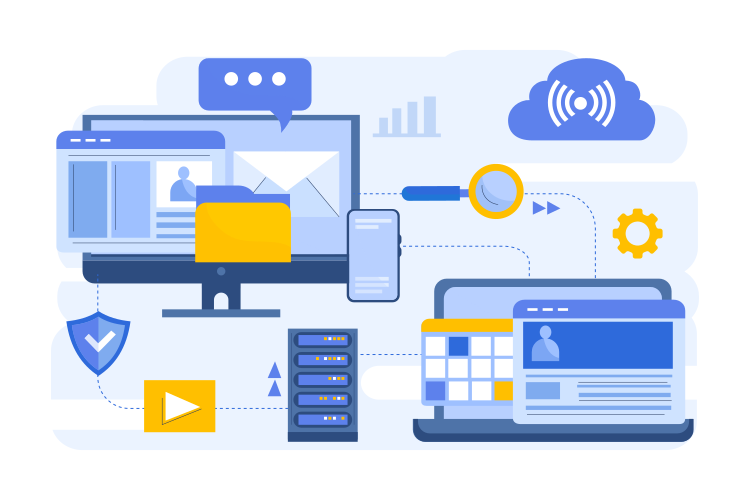
Many companies operate with isolated software solutions.
This often leads to problems such as:
- duplicate data maintenance
- manual data transfers
- inconsistencies between systems
- error-prone processes
- limited scalability
A well-designed integration architecture eliminates these issues.
Systems communicate directly with each other and exchange data automatically.
🏗️ Typical integration architecture
Digital Platform
│
├─ ERP System
├─ Online Shop
├─ CRM System
├─ EDI Integration
├─ Marketplace Integrations
└─ Custom Business Software
The integration layer ensures that these systems communicate reliably with each other.
It typically handles tasks such as:
- API communication
- data mapping
- transformation of data formats
- process automation
- error handling
- monitoring
🔌 API Integration
Most modern systems provide APIs that allow them to communicate with other platforms.
API integration makes it possible to connect different systems reliably.
Typical examples include:
- shop APIs
- ERP APIs
- CRM APIs
- payment providers
- shipping providers
- marketplace APIs
Through API integration, data can be exchanged between systems in real time.
🛒 Integration of eCommerce platforms
System integration is particularly important in eCommerce environments.
An online shop usually needs to be connected with several systems:
- ERP systems
- payment providers
- shipping providers
- marketplaces
- marketing platforms
- CRM systems
A stable integration architecture ensures that these systems work together reliably.
👉 Learn more: eCommerce Development
🧩 Integration of ERP systems
ERP systems are often the central platform within a company.
System integration ensures that ERP systems can be connected with other platforms.
Typical integrations include:
- product data synchronization
- order transfer
- pricing logic
- inventory levels
- invoicing processes
🤝 Integration of external partners
Many business processes also require the integration of external partners.
Examples include:
- suppliers
- logistics providers
- marketplaces
- payment providers
These integrations are often implemented via APIs or EDI.
⚠️ Challenges in integration projects
Integration projects are often complex because different systems have different requirements.
Typical challenges include:
- different data models
- different APIs and interfaces
- synchronization of data
- performance and scalability
- monitoring and error handling
A robust integration architecture considers these aspects from the very beginning.
🧑💻 Our role in integration projects
We help companies integrate their system landscapes in a sustainable and scalable way.
Typical responsibilities include:
- analyzing existing system landscapes
- designing the integration architecture
- developing custom interfaces
- implementing API integrations
- building scalable integration platforms
- operating and continuously improving integrations
Our goal is to connect software systems in a way that they operate like a single digital system.
👉 Talk to us about your project